
Sepsis is a life-threatening condition in which the body’s response to infection damages its own tissues and organs. It can develop quickly, so you often need to make clinical decisions before you know which pathogen is involved.
In suspected bacterial sepsis, this creates a familiar challenge. You need to treat early, but you also need to know whether bacteria are present, which species may be involved, and whether broad-spectrum antibiotics can be adjusted. Rapid sepsis diagnosis starts with clinical assessment, but rapid diagnostics of bacteria in sepsis can help you reduce uncertainty by shortening the time to pathogen identification in sepsis.
Current bloodstream infection diagnostics rely primarily on blood culture. Once a culture turns positive, identification follows, either by MALDI-TOF or targeted molecular testing, the latter offering some speed advantage over MALDI-TOF but still part of the same sequential workflow. The critical bottleneck is not the identification step: it is the time to culture positivity itself, which typically takes one to several days and cannot be accelerated by any downstream method. In the early phase of suspected sepsis, this means you are often making treatment decisions without microbiological confirmation.
We developed Molecular Culture® to help close this gap. Rather than waiting for bacterial growth, it identifies bacterial species directly from blood using a broad-spectrum molecular approach. By delivering same-day results, broad species-level coverage, and reliable negative results, Molecular Culture® provides clinically relevant information at the point in the workflow where uncertainty is highest.

The clinical and economic need for faster bacterial identification
Sepsis remains one of the major global health challenges. According to the World Health Organization, sepsis affects an estimated 49 million people and causes 11 million deaths globally every year (1). For you as a clinician, microbiologist, or hospital decision-maker, the challenge is practical: sepsis can progress quickly, while pathogen identification often takes longer than the treatment window allows.
When you suspect sepsis, empirical antibiotic treatment is often necessary. This protects patients when the risk of untreated infection is high. It also places pressure on antimicrobial stewardship because broad-spectrum therapy may continue when the causative organism remains unknown. Faster sepsis pathogen identification can help you refine treatment earlier, especially when you need to confirm infection, adjust therapy, or rule out bacterial involvement with more confidence.
Faster bacterial identification can help reduce unnecessary antibiotic use by providing earlier information on whether bacteria are present and which species may be involved. This is where antimicrobial stewardship diagnostics become clinically relevant: results need to support treatment refinement, not only detection. When bacterial infection can be ruled out with greater confidence, diagnostic tests for antibiotic de-escalation may help reduce unnecessary exposure to broad-spectrum antibiotics. This matters in the context of rapid diagnostics to prevent antimicrobial resistance, because WHO identifies the misuse and overuse of antimicrobials as a major driver of the emergence of drug-resistant pathogens, while trusted negatives help to support earlier de-escalation and reduce unnecessary broad-spectrum antibiotic exposure.
The cost of delayed sepsis diagnosis is therefore not only clinical. It can also affect hospital workflows, antibiotic use, ICU capacity, and the duration of care. Current bacterial diagnostic methods take several days to yield results, which can delay correct treatment, prolong hospital stays, and negatively affect patient outcomes. For hospitals evaluating the economic impact of rapid diagnostics, diagnostic stewardship is especially relevant: the right test at the right time, with results that support earlier clinical decisions.
This need is especially clear in high-acuity settings such as the ICU, where treatment decisions are made within hours. It is also relevant in neonatal and pediatric care, where clinicians need to balance the risk of undertreating serious infection with the risk of unnecessary antibiotic exposure. In an international study of 757,979 late-preterm and term infants, 21,703 received intravenous antibiotics in the first postnatal week, while only 1.7% of treated infants had culture-proven early-onset sepsis (2). In suspected sepsis, faster bacterial insight can help clinicians interpret uncertainty earlier. While sepsis length-of-stay reduction depends on multiple clinical and operational factors, faster bacterial identification can inform decisions about escalation, de-escalation, and subsequent patient management.
For hospitals, the practical question is clear: can diagnostics give you useful information early enough to guide decisions?
Current diagnostic approaches and their limitations
When you suspect bacterial sepsis, blood culture remains an important diagnostic method. It can detect viable bacteria and support further characterization. However, the limitations of blood cultures are especially relevant when treatment decisions need to be made before culture results are available. Culture-based workflows take time, and blood culture sensitivity may drop after antibiotic administration because the method depends on bacterial growth.
Molecular tests, including PCR-based methods, can provide faster identification than MALDI-TOF, but most currently available assays are designed to be performed only after blood culture becomes positive. They accelerate the identification step within the existing workflow, but do not address the time to culture positivity. In addition, their diagnostic value depends on assay design: if the causative organism falls outside the panel, uncertainty persists. This is a relevant limitation in suspected bloodstream infection, where the bacterial cause is often unknown at the onset of care.
Together, these limitations create a diagnostic gap. You need rapid information, broad bacterial detection, and reliable interpretation of negative results. Even a fast test with limited coverage may still leave uncertainty when the result is negative. If you cannot confirm or rule out bacterial infection with sufficient confidence, broad-spectrum antibiotic treatment may continue while the diagnostic picture remains incomplete. This is why hospitals are increasingly evaluating blood culture alternatives that can provide earlier bacterial insight while still supporting clinically useful interpretation.
Direct molecular testing in bloodstream infection diagnostics
Direct molecular testing detects bacterial genetic material rather than relying solely on bacterial growth. In suspected bloodstream infection, its clinical value depends on the ability to detect relevant bacteria directly from the available sample, provide sufficient breadth beyond predefined targets, and return results in time to support patient management. The central question for molecular diagnostics in bacterial infections is whether the test can provide actionable information early enough to influence clinical decisions.
Many existing molecular approaches are based on predefined panels. Multiplex PCR bacterial identification is effective when the pathogen is included in the assay, but uncertainty remains if the organism is not covered. Untargeted PCR diagnostics aim to broaden detection by identifying bacteria without relying on a narrow predefined target list. For high-acuity infectious disease workflows, molecular testing must combine speed, breadth, sample compatibility, and reliable interpretation.
Broad molecular testing has been discussed in clinical diagnostics for many years. Several technical barriers have limited routine use in high-acuity settings such as the NICU. Narrow panels can miss organisms outside the assay design and do not provide the same confidence in negative results. Blood can contain inhibitory factors that affect PCR performance. Low sample volumes require highly sensitive assays. NGS-based approaches can offer breadth, but are often too slow for acute decision-making and can be complicated by the overwhelming presence of human DNA.
Recent clinical work suggests that broad molecular testing is now being evaluated in samples and workflows where conventional culture can be limited. In pleural effusion diagnostics, a 2026 study evaluated Molecular Culture ID in 440 residual samples and reported pathogen detection in 133 samples, compared with 55 positives by routine culture (3). In critical care, recent sepsis-focused data presented at ESCMID 2026 describe molecular detection directly compared with blood culture in ICU patients with suspected sepsis, including concordant and discordant results, contaminants, unclear signals, and clinical interpretation.
These developments bring molecular testing closer to the questions you face in acute infection care: how can you identify pathogens faster, detect bacteria more broadly, and interpret results when culture alone does not provide timely or complete answers?
How Molecular Culture® addresses this need
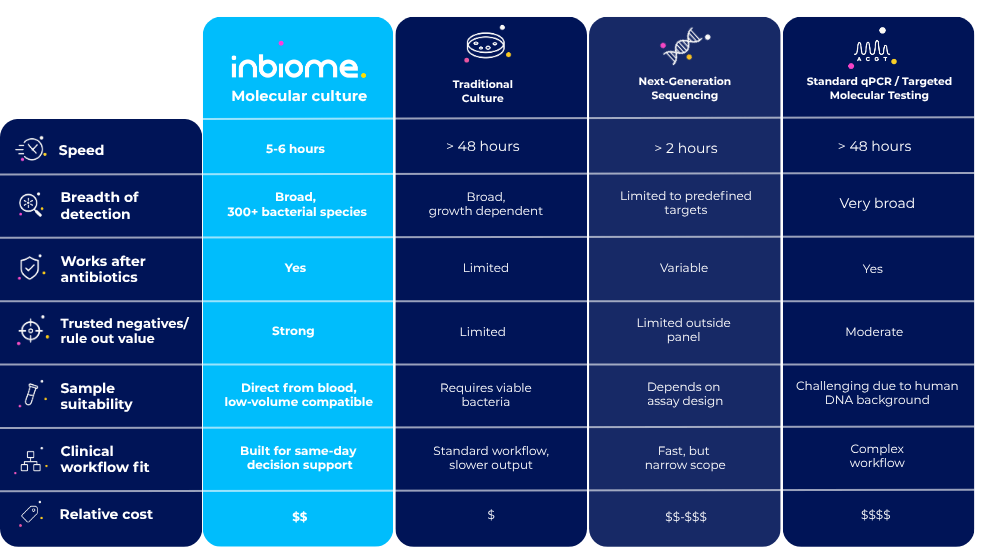
Molecular Culture® was developed to provide faster and broader bacterial insight from clinical samples. For suspected sepsis and bloodstream infection diagnostics, it can identify more than 300 bacterial species at the species level directly from blood. For bacterial bloodstream infection diagnosis, this means you can look beyond predefined panels while keeping the focus on clinically useful interpretation.
This breadth matters because suspected sepsis often starts without a clear expected pathogen. Broad-spectrum molecular testing can help you move beyond the limitations of fixed panels and generate useful information when the bacterial cause is uncertain. For teams comparing sepsis diagnostic methods, breadth becomes especially relevant when early treatment decisions cannot wait for culture.
Molecular Culture® is a same-day method for bacterial identification directly from blood. This can support earlier rapid bacterial identification from blood and help your laboratory provide information hours to days before traditional culture results become informative.
Negative results also have clinical value. Excluding bacterial infection can be as important as identifying the pathogen, particularly when broad-spectrum antibiotics have already been initiated. Reliable negative results may support earlier de-escalation when bacterial infection is unlikely. This is especially relevant in suspected culture-negative sepsis, where culture results do not fully resolve the clinical question.
Molecular Culture® also remains diagnostically relevant after antibiotic exposure because it detects bacterial DNA rather than relying only on organism growth. This is important when you need answers from patients who have already started treatment, where traditional culture sensitivity may be reduced.
Towards faster and more reliable bacterial sepsis testing
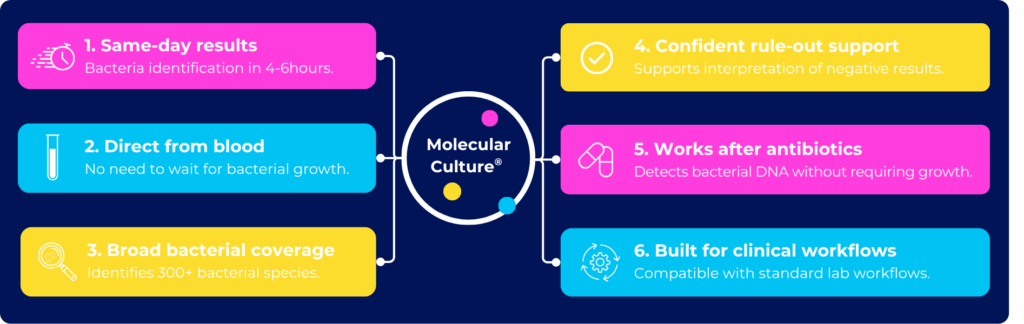
Rapid sepsis diagnostics should provide more than speed. In suspected bloodstream infection, you need diagnostics that identify bacteria when present, support interpretation when bacteria are not detected, and fit into the laboratory workflow where the test will be used.
Molecular Culture® is designed for this early and uncertain phase of sepsis care. By combining direct-from-blood bacterial identification, broad species-level detection, same-day results, and trusted negatives, it can support more informed decision-making in suspected bacterial sepsis.
For intensive care unit teams, microbiology laboratories, infectious disease specialists, and researchers, molecular testing can provide earlier insight into bacterial presence and identity. Earlier sepsis pathogen identification supports treatment refinement, antimicrobial stewardship, and further research into bloodstream infection diagnostics.
References
- World Health Organization: WHO & World Health Organization: WHO. (2024, May 3). Sepsis. https://www.who.int/news-room/fact-sheets/detail/sepsis
- Dimopoulou, V., Klingenberg, C., Navér, L., Nordberg, V., Berardi, A., El Helou, S., Fusch, G., Bliss, J. M., Lehnick, D., Guerina, N., Seliga-Siwecka, J., Maton, P., Lagae, D., Mari, J., Janota, J., Agyeman, P. K. A., Pfister, R., Latorre, G., Maffei, G., Laforgia, N., … AENEAS Study Group (2025). Antibiotic exposure for culture-negative early-onset sepsis in late-preterm and term newborns: an international study. Pediatric research, 97(5), 1629–1635. https://doi.org/10.1038/s41390-024-03532-6
- Remijas, L., Bos, M. P., Sánchez, M. M., van Houdt, R., Rohde, G., & Budding, A. E. (2026). Advancing pleural effusion diagnosis: Application of Molecular Culture ID in pathogen detection. Journal of microbiological methods, 242, 107395. https://doi.org/10.1016/j.mimet.2026.107395
More updates, articles and news.
Sepsis Diagnosis: The Role of Molecular Diagnostics in Faster Pathogen Identification
Sepsis is a life-threatening condition in which the body’s response to infection damages its own tissues and organs. It can…

Molecular Diagnostics Data Presented at ESCMID 2026
Faster Diagnostics for Critical Infections At ESCMID 2026, Inbiome presented new clinical data focused on how molecular diagnostics can accelerate…
Inbiome Secures $16M Investment for Diagnostics
Investment Supports Expansion of Molecular Diagnostics Dutch diagnostics company Inbiome has secured a $16 million investment round from a consortium…